
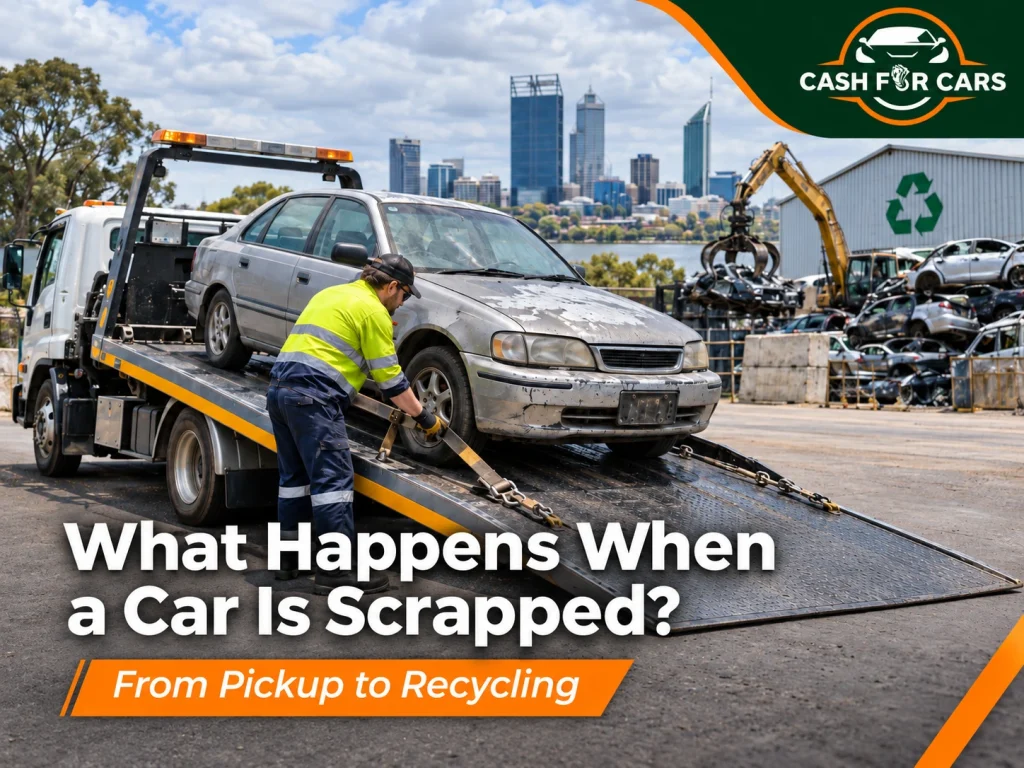
If your old car has finally given up, you’re probably thinking about booking a scrap car removal. Before you do, it’s fair to wonder what happens when a car is scrapped. Does it get flattened and dumped, or does any of it get used again?
Most of it does get used again. Parts that still work go into other cars, and the metal is melted down and made into something new. Here’s how it all happens in Western Australia, from the moment the tow truck arrives to the day the metal is recycled.
What happens when a car is scrapped?
When a car is scrapped, a wrecker collects it and checks who owns it. Every fluid is drained, and dangerous parts like the battery and airbags are taken out. Parts that still work are removed and sold. The bare shell is then crushed, shredded and sorted, and the metal is sold to make new steel and aluminium.
The order matters. If a car were crushed with fuel, oil, a battery or live airbags still inside, it could catch fire or leak oil and acid into the ground. That’s why the dangerous parts always come out first.
How is a car scrapped, step by step?
Here’s the car recycling process in order. The details change a little from yard to yard, but the steps stay much the same.
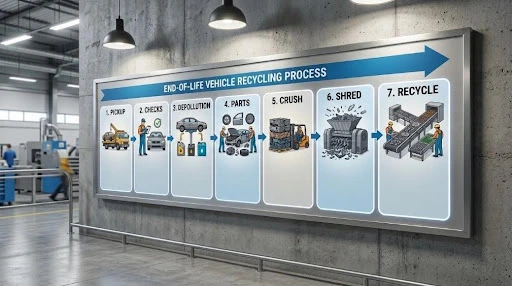
1. Quote, pickup and handover
It starts with a price. You share your car’s make, model, year and condition, and the wrecker works out an offer from that. Before you book, it’s worth checking the wrecker’s list of Perth suburbs covered for pickup, so you know the truck can actually reach you. Your car doesn’t need to start or drive, because a tow truck can winch it on.
When the driver arrives, you’ll be asked for photo ID and proof that the car is yours. The driver also writes down the vehicle identification number, or VIN. On most cars, it’s a 17-character code on a plate in the engine bay or at the bottom of the windscreen. It ties the sale to that exact car.
2. Checks and logging at the yard
Back at the yard, the car is booked in, and the VIN is checked against your paperwork. This is how the wrecker confirms the car wasn’t stolen and that you had the right to sell it.
Wreckers also work with the national Written-Off Vehicle Register, or WOVR. It tracks written-off vehicles up to 15 years old, mainly to stop stolen cars from getting a fake identity and going back on the road. If a wrecker takes in a written-off car, or dismantles one that isn’t on the register yet, they have to report it. After the checks, someone looks the car over and notes which parts are worth saving.
3. Depollution: draining fluids and removing hazards
Depollution simply means taking out everything that could hurt people or the environment.
First, the fuel, engine oil, transmission fluid, brake fluid, coolant and windscreen washer fluid are drained and stored separately, so each one can be recycled or disposed of safely. Then the battery comes out. The gas in the air conditioner is pumped into a sealed cylinder, and anyone who removes refrigerant in Australia must hold a refrigerant handling licence. Airbags and seatbelt pretensioners contain small explosive charges, so they’re either removed or set off under control. Some older cars also have mercury switches in the bonnet or boot lights, and these come out too.
Hybrids and electric cars need extra care. Their high-voltage batteries can still hold a charge even when the car is dead, and a damaged battery can catch fire. Trained staff remove them before the car goes anywhere near a crusher.
This step is the main reason to choose licensed car wreckers in Perth over someone who only wants the scrap metal.
4. Saving parts that can be reused
With the hazards gone, the useful parts come off. They’re checked, cleaned and sold second-hand, which gives other drivers a cheaper way to keep their own cars running.
Say you’re scrapping a 2008 sedan with a blown engine. The engine may only be worth its weight in metal, but the gearbox, alternator, starter motor, radiator, doors, headlights and wheels could all find new owners. The catalytic converter comes off as well, because it holds small amounts of precious metals. The table further down shows the main parts and where each one ends up.
5. Crushing the stripped shell
Once the parts are gone, all that’s left is the bare body shell, which people in the trade call a hulk. It’s flattened or pressed into a block, so one truck can carry several to the metal recycler in a single trip. Some wreckers crush on site, while others send the shells to a licensed metal recycler.
6. Shredding and sorting the metal
So what happens to crushed cars after that? They’re fed into a large industrial shredder that tears them into chunks about the size of your fist.
Magnets pull out the steel and iron. Other machines separate the metals a magnet can’t pick up, like aluminium and copper. The leftovers are a mix of plastic, foam, fabric, rubber and bits of glass, known as shredder residue or floc. There are few ways to reuse it in Australia at the moment, so most of it goes to landfill.
7. Metal back into manufacturing
The sorted metal is sold to steel mills and smelters in Australia and overseas. There it’s melted down and made into new products, such as building materials, appliances and car parts.
What parts do wreckers remove before crushing?
Wreckers take out the hazardous items first: fluids, the battery, air-conditioning gas and airbags. Next come the parts that can be resold or that hold valuable metal, such as the engine, gearbox, catalytic converter, wheels and lights. Only the stripped shell goes on to the crusher.
| Part | Why it comes out | Where it goes |
| Fuel, oils, coolant, brake and washer fluid | Can pollute soil and water | Recycled or safely disposed of |
| Lead-acid battery | Contains lead and acid | Battery recycler |
| Air-conditioning gas | Can damage the ozone layer or add to global warming | Recovered by a licensed technician |
| Airbags and seatbelt pretensioners | Contain explosive charges | Removed or set off safely |
| Hybrid or EV high-voltage battery | Risk of fire and electric shock | Specialist handling and recycling |
| Catalytic converter | Holds platinum, palladium and rhodium | Precious metal recovery |
| Engine and gearbox | May still work or be rebuilt | Resold, rebuilt or scrapped for metal |
| Alternator, starter motor, radiator | Often still in working order | Sold as second-hand parts |
| Wheels and tyres | Rims and good tyres can be resold | Reused or recycled |
| Doors, bonnet, lights, mirrors, seats | Common replacement parts | Sold second-hand |
| Wiring and electronics | Reusable or full of copper | Resold, or copper recovered |
How much of a scrapped car is recycled?
About 850,000 vehicles reach the end of their life in Australia each year, roughly 5% of all vehicles on our roads. A 2024 national motor industry study, also submitted to the Productivity Commission, found that about 70% of the material from these vehicles is recovered. Most of the rest goes to landfill.
So when people ask what happens when a car is scrapped in Australia, the honest answer is that most of it is saved, but not all of it. Cars are made mostly of steel and iron, and metal is the part the industry recovers best, because it can be sorted by machine and sold.
Plastics, foam, fabric and glass are harder to deal with. Australia has few large-scale ways to recycle these materials from cars, which is why they make up most of the shredder residue. End-of-life vehicle recycling is still developing here. The same study suggests Australia could follow the UK and EU, where the goal is to reuse or recycle at least 85% of each car by weight, but no Australian target has been set yet.
If you’re wondering what your own scrap car is worth, it mostly comes down to its weight, how much metal it holds and how many parts can be resold.
What to do before your car is scrapped in WA
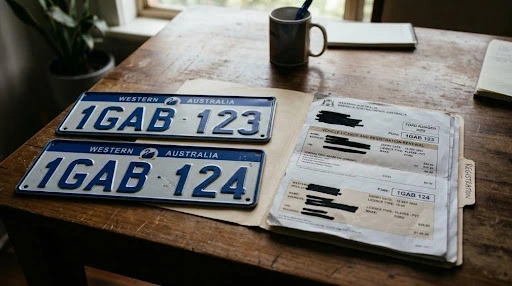
Your part of the job is small. You need to clear out the car, have your papers ready, and sort out the licence, plates and insurance.
- Clear out the car. Check the glovebox, boot, door pockets and under the seats. Take out toll tags, the garage remote and any parking permits.
- Have photo ID and proof of ownership ready. Registration papers in your name are the simplest proof.
- Tell DTMI within 7 days. If the car is still licensed when you sell it, you must notify the Department of Transport and Major Infrastructure (DTMI, formerly the Department of Transport) within 7 days. You’ll need the buyer’s name and address. Transfers to a business can’t be done online, so you’ll usually fill in the MR9 form and lodge it at a DTMI service centre or regional agent, or post it. Missing the deadline can lead to a penalty.
- Return the number plates. Plates from a cancelled licence go back to a DTMI service centre or regional agent, or by post with a short note explaining why. They can’t be handed in at the Joondalup Driver Assessment Centre or Perth metro Australia Post outlets. If you have personalised plates you want to keep, swap them over before you sell.
- Cancel your insurance and check for a refund. If your licence still has time left, you may get some money back. The refund counts from the day your plates are returned, so it’s best not to leave them in the shed.
WA Cash for Cars: Old car taking up space? We’ll come and get it
WA Cash for Cars buys unwanted cars, trucks, 4WDs, vans and utes across Perth, whether they run or not. Removal is free, so you won’t pay a cent to have your old car towed away. Call 0414 928 631 and tell us three things: the make and model, what’s wrong with it, and which suburb it’s in. We’ll give you a free quote, and you can decide from there.
Disclaimer: This guide explains how car scrapping generally works in WA. Every wrecker and metal recycler runs things a little differently, and government rules can change. Check the official government pages linked in this guide before you sell, and treat it as general information, not legal advice.
FAQs
Can I scrap a car that still has finance on it?
Not until the loan is sorted. If you still owe money, the lender may have a security interest over the car, which means they could take it back even after it’s sold. You can check with a search on the Personal Property Securities Register (PPSR) for a small fee. Pay out the loan first, or ask your lender for a letter confirming what their registration covers.
How do I scrap a car that belonged to someone who has died?
The executor of the estate, or a family member entitled to the car, usually handles it. In WA, you’ll need a Declaration of Deceased Estate (E172) form, a certified copy of the death certificate, the will or letters of administration, and proof of ID. This can’t be done online, so it’s lodged at a DTMI service centre or regional agent, or by post.
Can I take parts off my car before I scrap it?
Yes, it’s still your car. Just tell the wrecker before they give you a price, because most quotes assume the car is complete. Taking out the engine, wheels or catalytic converter can lower the offer, so check whether it’s worth the effort first.
Can a written-off car be fixed and driven again?
It depends on how it was written off. In WA, a statutory write-off can never be licensed again, so it can only be used for parts or scrap. A repairable write-off can go back on the road once it’s fixed and passes a written-off vehicle inspection. Your insurer’s paperwork will tell you which type you have.